Séisme Haiti
12 janvier 2010 - Magnitude 7.2

jeudi 8 avril 2010 par Martin Vallée

 Geoazur has been analysing the main shock of Haiti crisis using differents methods described below :

  1.  the Fast Teleseismic Bodywaves Source Inversion method
  2.  Array Analysis


1. Fast teleseismic body-wave source inversion

Martin Vallée (Géoazur, IRD, Nice, France, vallee@geoazur.unice.fr)
Jean Charléty (Géoazur, CNRS, Nice, France, charlety@geoazur.unice.fr)
Collaboration with LDG/CEA

 
Method

 We have deconvolved the compressive (P, PcP, PP) and transverse (SH,ScS) teleseismic waves recorded by FDSN-Geoscope stations to simultaneously retrieve the focal mechanism, moment magnitude and source time functions (Frequency band : 0.005Hz -0.17Hz).

 Remarks

 Large transpressive shallow earthquake (Mw 7.2 ; Figure 1). The event appears to be complex. It starts with a first impulsive moment release lasting about 10s (equivalent to Mw 7.1). During the minute following this first event, other source emissions seem to occur (see Figure 2), which increases the seismic moment. Inspection of seismic waveforms indicates that this subsequent moment release is likely to have a different mechanism from the first major event. 

This long duration is confirmed by array analysis, using a subset of USarray or a subset of the European network (see next part)


Figures

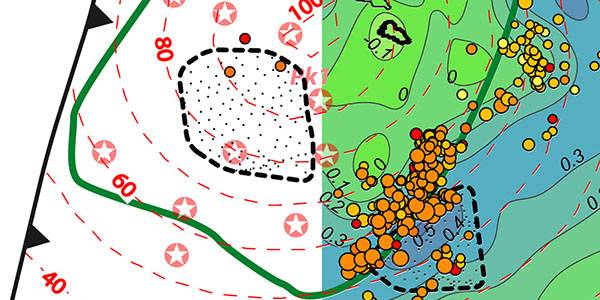
Figure 1 : Source parameters, uncertainties and agreement with teleseismic data. (Top left) Optimal values of moment magnitude, depth and focal mechanism. (Bottom left) Uncertainty analysis : misfit and moment magnitude changes as a function of dip and depth variations around their optimal values. Optimal dip and depth are indicated by the white diamond (the best misfit value is also shown). The thick line is the iso-misfit contour (noted C1) joining points with misfit 10% larger than the best value. The four thin lines are the iso-misfit contours joining points with misfit 25%, 50%, 75% and 100% larger than the best value. Moment magnitude associated with each (dip-depth) couple is shown with the colorscale. Acceptable values of dip, depth and magnitude are those which are inside the C1 contour. (Right) Agreement between data (black) and synthetics (red), both for compressive (i.e. P, PcP, PP) waves and transverse (i.e. S, ScS) waves (frequency band : 0.005-0.03Hz). Name of the station, azimuth, distance and maximum amplitude (in microns) are shown for each signal.


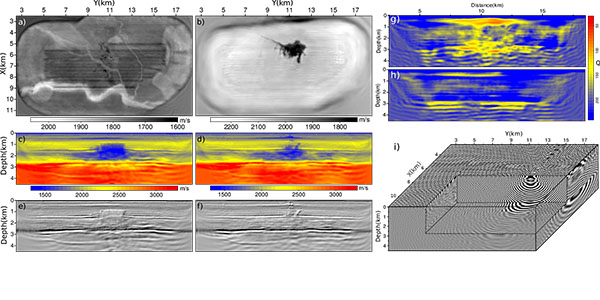
 Figure 2 : Broadband Source time functions (RSTFs), in the time and frequency domains. (Top left) Optimal values of moment magnitude, depth and focal mechanism. (Bottom left) Spectrum of the compressive RSTFs. The classical omega-2 slope is shown in the left part of the figure. (Right) Broadband RSTFs, in the time domain, for compressive waves. For each RSTF, the name of the station, its azimuth and epicentral distance are shown. 


2. Array Analysis

Martin Vallée (Géoazur, IRD, Nice, France, vallee@geoazur.unice.fr)


Method and remarks

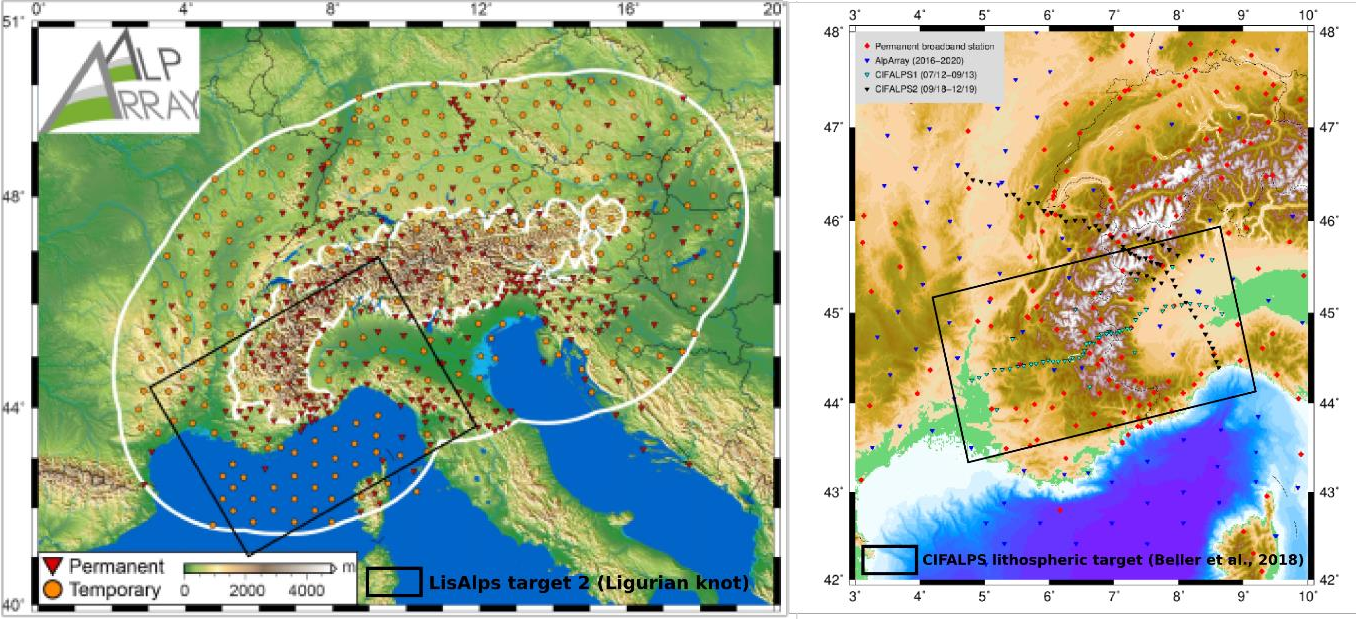
We use the method of Krüger and Ohrnberger (2005) and Vallée et al. (2008) to locate the coherent P-wave arrivals accross a subset of USArray (see Figure 4) and accross a subset of the European network (IV, GR, CH and NL arrays ; Figure 6). In Figure 5 and 7, the high values of semblance indicate that coherent P-wave arrivals are detected for more than 1 minute. This is a direct indication that the Haiti earthquake also lasted more than 1 minute, as proposed in the previous part.

Several energy bursts are seen, but all of them appear to be located close to the hypocentral region. Due to USarray-Haiti geometry we search for a source propagation along a 255° striking fault (figure 5), but all energy bursts remain close to the initial location. With the Europe-Haiti geometry, we can explore the propagation along a 151° striking fault, corresponding to the other nodal plane (figure 7). No clear deviation from the location found with the first P-wave arrival can be seen neither.

As a preliminary result, it seems that the Haiti earthquake has a very long duration associated associated with a very concentrated rupture area.


Figure 4 : Location of the USArray stations used in the array analysis


Figure 5 : Detection of the P-waves coherent across the USarray subset. High values of semblance (color scale) indicate that P waves are detected accross the array. The long time during which these P waves are detected shows that the source of the Haiti earthquake lasted more than one minute. Several energy bursts can be seen, but none of them is clearly located away from the region where first arrivals are detected (hypocenter). This is shown by the vertical axis which indicates the energy location along the fault (the strike is assumed here to be 255°, and the origin is the epicenter). 


 Figure 6 : Location of the European stations (arrays IV, GR, CH and NL) used in the array analysis

Figure 7 : Detection of the P-waves coherent across the European array subset. High values of semblance (color scale) indicate that P waves are detected accross the array. The long time during which these P waves are detected shows that the source of the Haiti earthquake lasted more than one minute. Several energy bursts can be seen, but none of them is clearly located away from the region where first arrivals are detected (hypocenter). This is shown by the vertical axis which indicates the energy location along the fault (the strike is assumed here to be 151°, and the origin is the epicenter).


References :

Krüger, F., and M. Ohrnberger (2005), Tracking the rupture of the Mw = 9.3 Sumatra earthquake over 1,150 km at teleseismic distance, Nature, 435, 937– 939, doi:10.1038/nature03696.

Vallée, M., M. Landès, N. M. Shapiro, and Y. Klinger (2008), The 14 November 2001 Kokoxili (Tibet) earthquake : Highfrequency seismic radiation originating from the transitions between sub-Rayleigh and supershear rupture velocity regimes,
J. Geophys. Res., 113, B07305, doi:10.1029/2007JB005520.